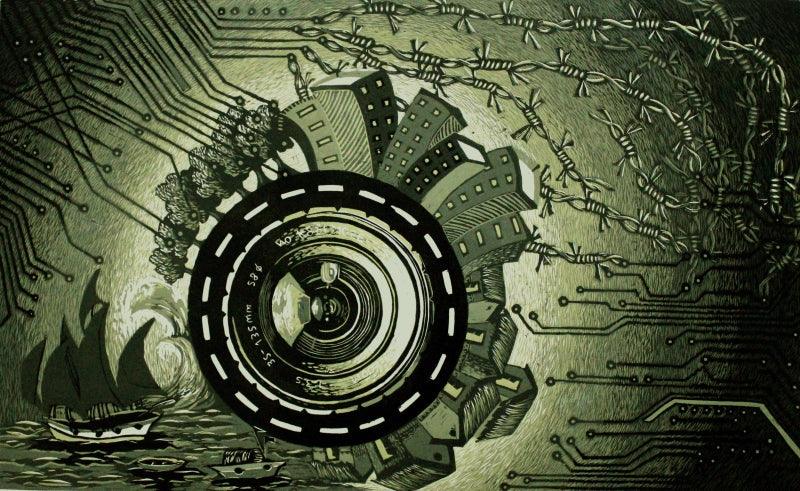
Conversation Around Lockdown (The Eye of Surveillance)
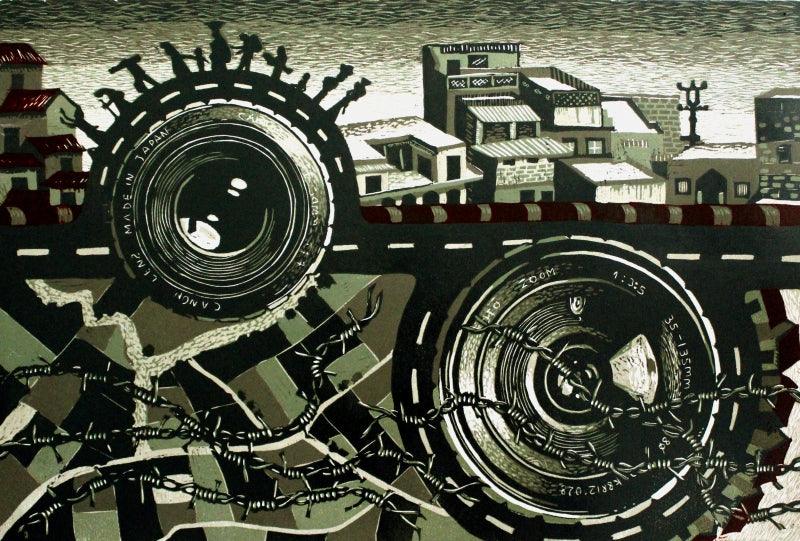
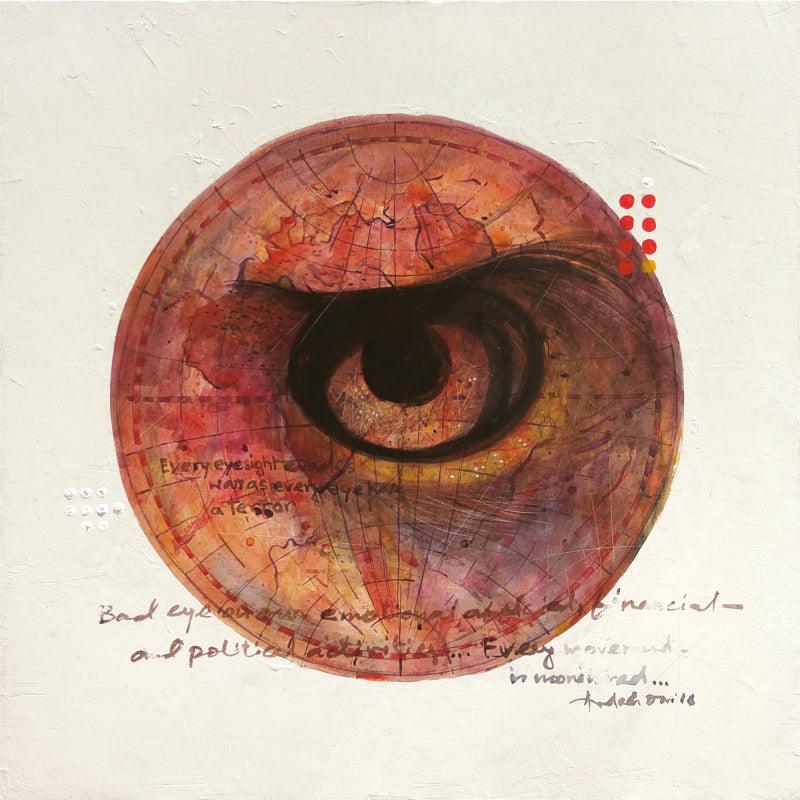
A camera lens becomes the work’s gravitational core, encircled by a road-like ring that reads as both orbit and treadmill—an emblem of how seeing is routed, regulated, and endlessly repeated. Around it, the city’s jagged silhouettes and a coastline with small boats press into the composition, while circuit-board tracery and barbed wire stitch the surface into a tense topology of surveillance, infrastructure, and containment. The muted, metallic palette and etched linework create a claustrophobic glow, suggesting a world where nature, travel, and even memory are filtered through engineered systems. In this collision of optics and architecture, the image proposes vision itself as a contested territory: at once a tool of wonder and a mechanism of control.
Delivery
You may also like