Mythological Scene Gm-00082601
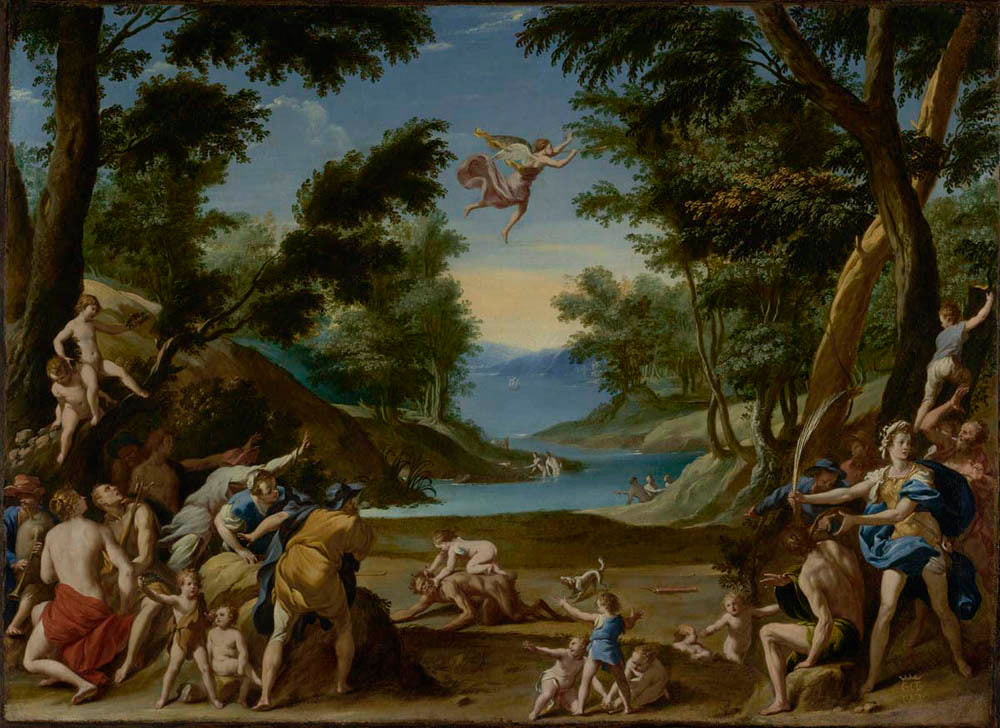
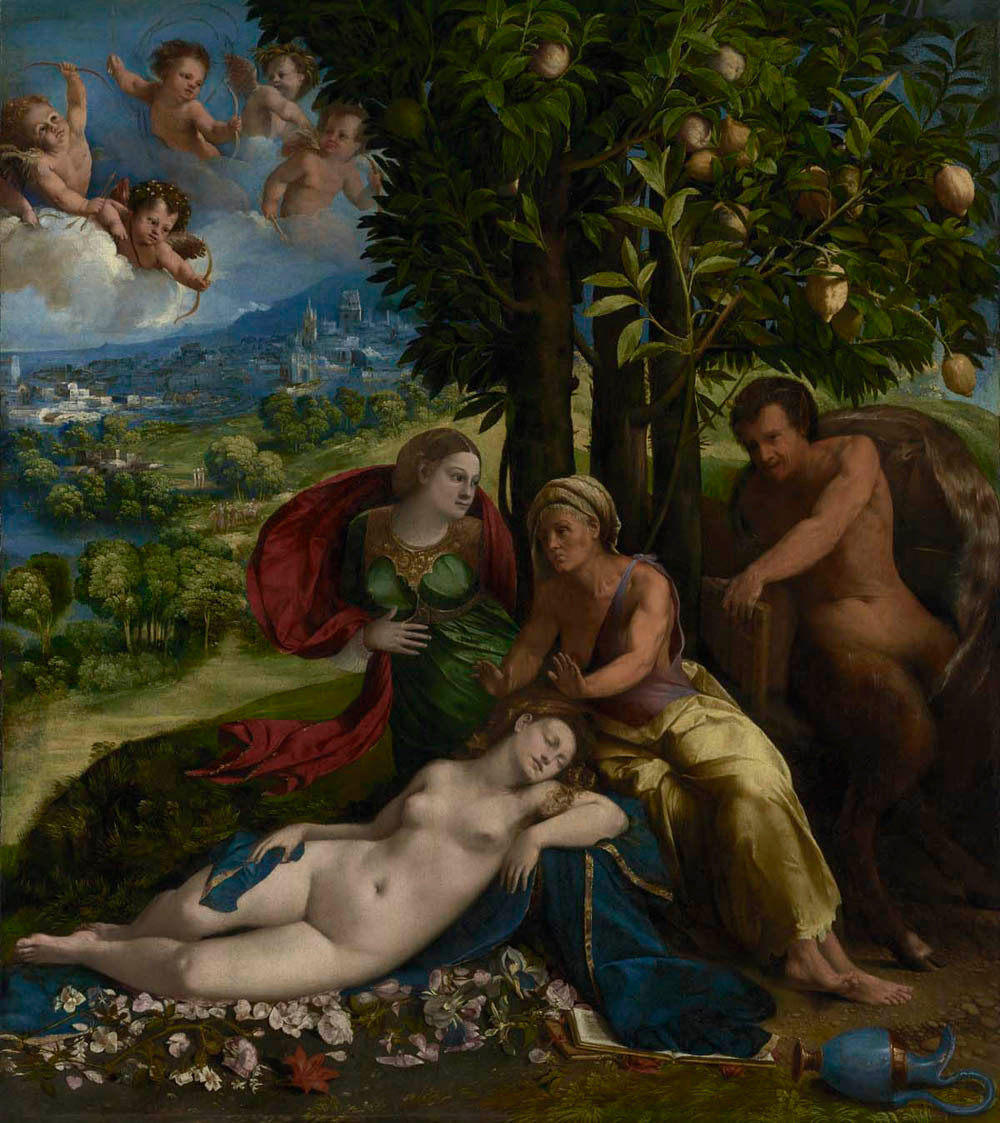
An array of enticing visual clues has given rise to many theories about Dosso Dossi's Mythological Scene, but no one has determined the painting's precise meaning, if the artist indeed intended for one to exist. The male figure on the right of the composition is the Greek pastoral god Pan, leading some scholars to refer to this work as the Allegory of Pan. Pan was a satyr, who in Renaissance allegories personifies lust. He owed his amorous reputation to his seduction of the nymphs by playing music on his syrinx, which he holds here in his left hand. The sleeping nude in the foreground may be the nymph Echo, who spurned Pan for Narcissus. The old woman at the center of the group is perhaps Echo's protector Gea (Earth), who sits above her and shields her from harm. The woman next to her, wearing armor over a green gown and enveloped by a billowing red cape, has yet to be identified. A group of erotes (winged gods of love) hover alongside the citrus trees.
Some scholars argue that Dosso wished to illustrate a specific episode from a single myth, relating to the life of Pan, perhaps originating from the works by the ancient poets Ovid or Nonnus. The painting may in fact lack a unified theme, but instead presents a mythologically inspired scene as a legitimating context for the depiction of eroticized bodies. The inclusion of meticulously painted citrus trees and flowers might have been intended to appeal to the educated viewer’s knowledge of science and nature. Dosso may here be encouraging the viewer to deliberate on the associated powers of nature, poetry, and art.
This painting underwent considerable alterations during the course of its creation. The artist originally covered the unidentified armored woman, painting a landscape over the top, but the figure was later uncovered during restoration in the nineteenth century. X-radiograph photography reveals a partially cut-off figure of a man under the lower part of the landscape, as well as a suit of armor and a sword hanging from the lemon tree, a bas viol (an instrument akin to a cello) held by the woman in the red cape, and a downward gaze on the face of the old woman. At least eight inches of the canvas were also cut away from the left side at some point in time. Dosso regularly revised his compositions in this manner, adding and subtracting figures and other key elements, contributing further to difficulties in identifying and understanding his subject matter.
Delivery
You may also like