

View of the Rhine River Valley (recto); View of the Heideberger Mill Near Cleves (verso) Gm-00018901
CHF 20
● In stockchecking live price…
Products
Note Cards (4.7" x 6.5") 12 x 16.5cm Pack of 4Giclee Matte Art Paper (18" x 24") 45 x 60cmStretched Canvas (18" x 24") 45 x 60cmStretched Canvas (24" x 36") 60 x 90cmGiclee Matte Art Paper (44" x 60") 112 x 152cmGiclee Matte Art Paper (24" x 36") 60 x 90cmGiclee Matte Art Paper (30" x 40") 75 x 100cmStretched Canvas (24" x 48") 60 x 122cmStretched Canvas (28" x 28") 70 x 70cmStretched Canvas (32" x 48") 80 x 122cmStretched Canvas (16" x 20") 40 x 50cmAelbert Cuyp (Dutch, 1620–1691) Aelbert Cuyp was mesmerized by Holland's flatness. Using a long, narrow sheet of paper, he expressed vastness in breadth by compressing the landscape into thin strata that continue off the sides of the page. By choosing a low horizon line, he extended the openness to include a large area of blank, cloudless sky. He created aerial perspective and conveyed the sense of endlessness in depth by drawing the foreground in black chalk and the background in silvery graphite. This view seems miniaturized: buildings, boats, figures, and even grazing animals are indicated by dots of chalk in the middle distance, while similar, even more abbreviated markings create a distant background.
Cuyp drew this scene in a sketchbook he made on his journey to southern Holland and northern Germany in 1651 and 1652, but the exact location remains unidentified.
The verso continues the scene from a sheet in the Musée Condé in Chantilly, France. The scene depicts Cleves, in present-day Germany, with this part showing the Heideberger Mill and a portion of the city wall. A slight discrepancy in size between the two sheets indicates that one or both of the pages was cut down.
Cuyp drew this scene in a sketchbook he made on his journey to southern Holland and northern Germany in 1651 and 1652, but the exact location remains unidentified.
The verso continues the scene from a sheet in the Musée Condé in Chantilly, France. The scene depicts Cleves, in present-day Germany, with this part showing the Heideberger Mill and a portion of the city wall. A slight discrepancy in size between the two sheets indicates that one or both of the pages was cut down.
Delivery
You may also like

Panoramic View of Dordrecht and the River Maas Gm-36716401
ArteHouse
CHF 20

A View of the Maas at Dordrecht Gm-00083201
ArteHouse
CHF 20

River Landscape Gm-00050401
ArteHouse
CHF 20

Landscape with the House with the Little Tower Gm-00004901
ArteHouse
CHF 20
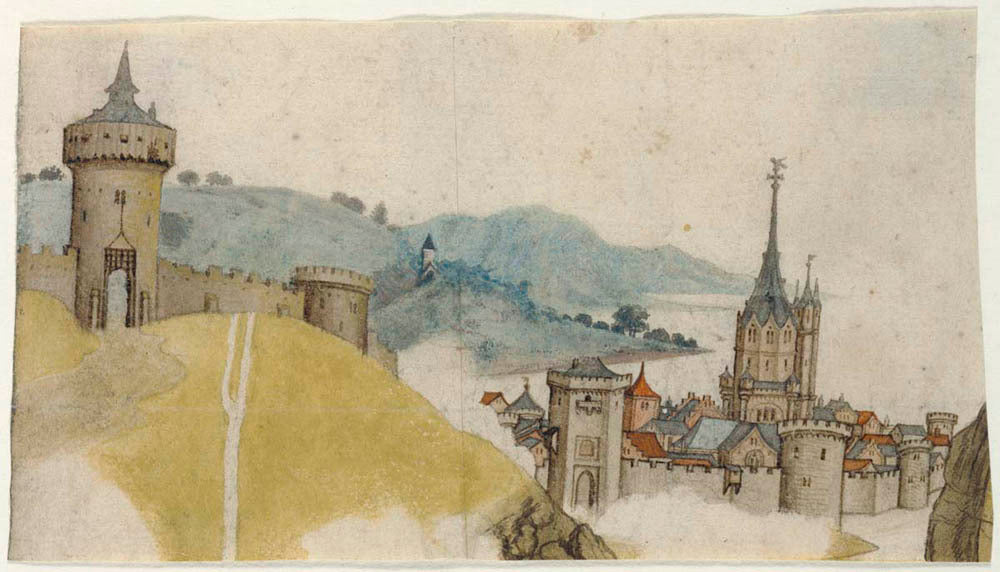
View of a Walled City in a River Landscape Gm-00027301
ArteHouse
CHF 20

Landscape with Haymakers Gm-00022901
ArteHouse
CHF 20

A Sailing Boat on a Wide Expanse of Water Gm-00011601
ArteHouse
CHF 20

Calm Sea Gm-14552501
ArteHouse
CHF 20