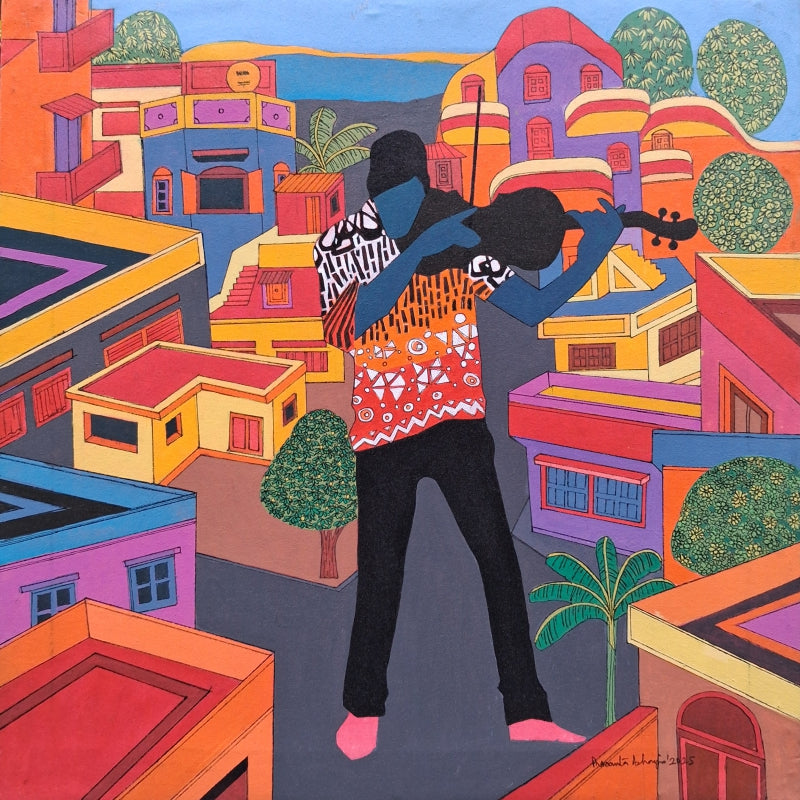
Symphony Of The Streets
₹69,000
● In stockchecking live price…
Size
24x24Type
OriginalMaterial
CanvasSet against a candy-bright geometry of rooftops and rounded facades, the silhouetted violinist becomes a quiet axis around which the town’s color and rhythm seem to circulate. The flattened perspective and bold, compartmentalized planes compress space into a stage-like intimacy, turning streets and balconies into beats in an unseen score. Patterned garments—partly script, partly ornament—suggest memory and cultural cadence carried on the body, while the dark figure’s anonymity invites the music to stand in for identity itself. In this charged contrast between luminous architecture and nocturnal presence, the painting reads as a hymn to how art can gather a community’s scattered forms into one sustaining, resonant moment.