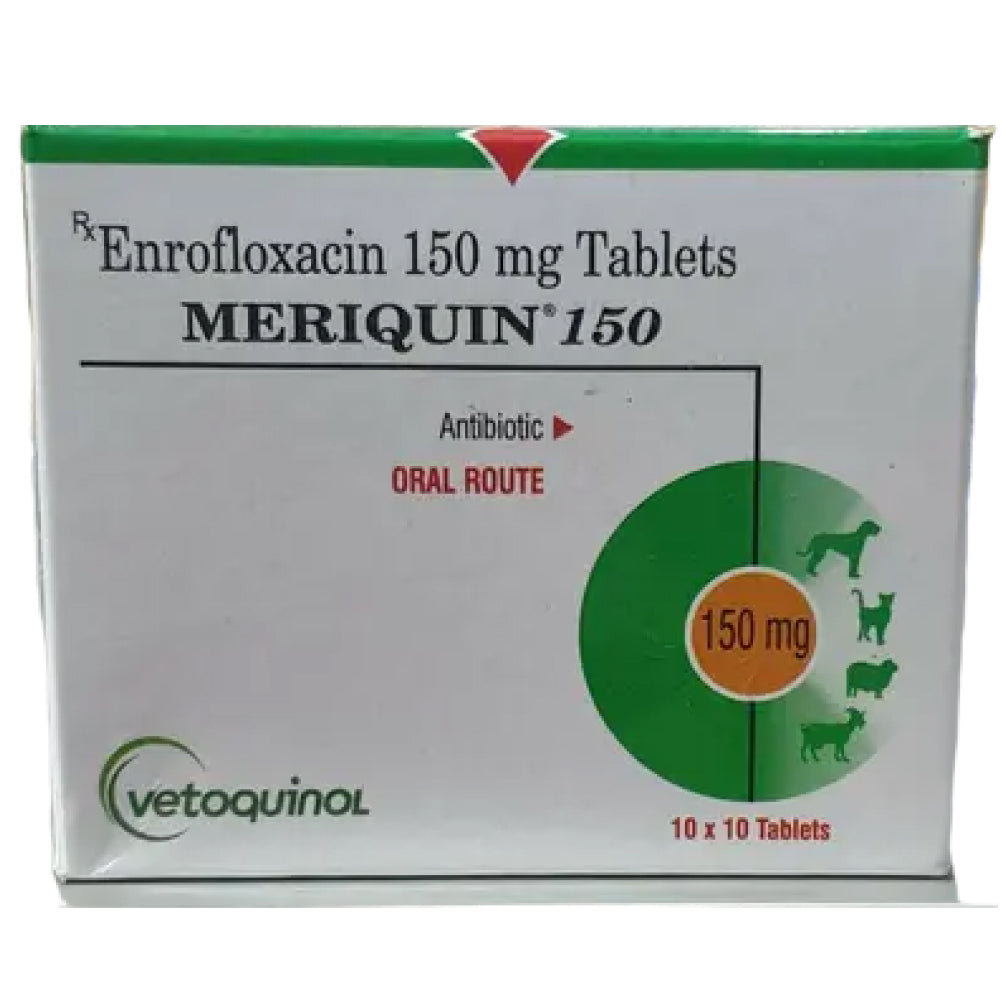
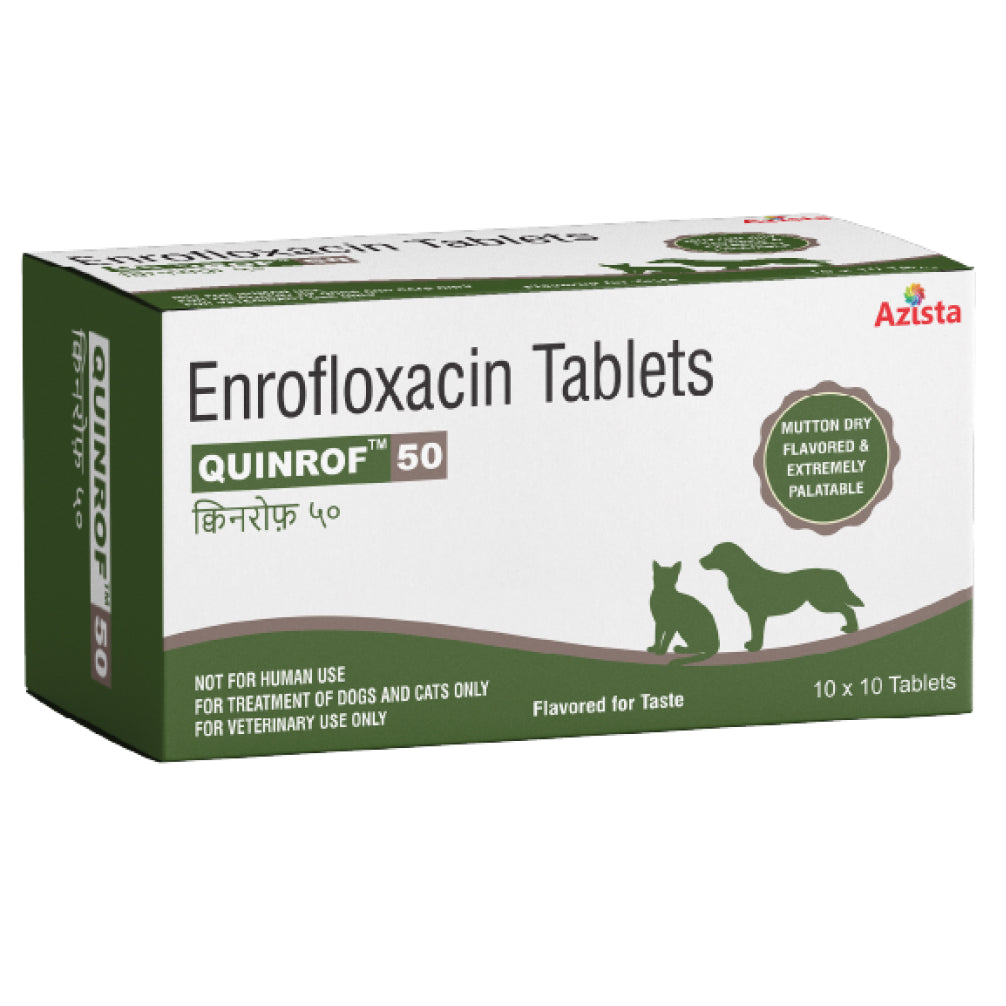
Vetoquinol Meriquin 50mg Enrofloxacin Tablets for Dogs and Cats
Vetoquinol Meriquin 50mg Enrofloxacin Tablet - Broad-Spectrum Fluoroquinolone Antibiotic for Dogs and Cats (Strip of 10, MRP ₹79)
Vetoquinol Meriquin contains Enrofloxacin IP 50mg per tablet - a second-generation fluoroquinolone antibiotic with broad-spectrum bactericidal activity against gram-positive and gram-negative bacteria. It treats skin and soft tissue infections, respiratory tract infections, reproductive tract infections, and GI tract infections in dogs and cats. Strip of 10 tablets, MRP ₹79. Schedule H - prescription required. Not for animals under 1 year of age.
Your dog has a recurring urinary tract infection that hasn't fully responded to a first-line antibiotic. Your cat has a respiratory infection with thick nasal discharge and laboured breathing. Your vet needs an antibiotic that reaches therapeutic concentrations across multiple organ systems after a single daily oral dose. Enrofloxacin - the active ingredient in Meriquin - is one of the most clinically trusted fluoroquinolone antibiotics in Indian veterinary practice, manufactured by Vetoquinol, a French veterinary pharmaceutical company with over 85 years of dedicated animal health expertise.
Marketed by Vetoquinol (SB), 5th & 6th Floor, Hamilton Building, B-Wing, Hiranandani Business Park, Hiranandani Estate, Ghodbunder Road, 400607.
Dr. Rinu Thomas, MVSc (8+ years):
"Enrofloxacin is particularly valuable in clinical practice for urinary tract infections - it's widely considered a drug of choice for UTIs in dogs because it achieves very high urinary concentrations after oral dosing, significantly exceeding the minimum inhibitory concentrations needed to clear E. coli and other gram-negative uropathogens. I also reach for it routinely in respiratory infections caused by Bordetella or Pasteurella, and in skin infections where culture results point to organisms resistant to first-generation antibiotics. The critical clinical caveat is the age restriction: enrofloxacin causes cartilage damage in growing joints and should never be used in dogs and cats under one year of age."
Uses and Benefits
- Skin and soft tissue infections - pyoderma, abscesses, infected wounds
- Respiratory tract infections - bacterial pneumonia, bronchitis, Bordetella, Pasteurella
- Urinary tract infections (UTIs) - drug of choice for UTIs due to high urinary concentration
- Reproductive tract infections - uterine, prostatic, and vaginal bacterial infections
- GI tract infections - bacterial enteritis and gastrointestinal infections
- Meningitis and rickettsial infections - effective against intracellular organisms
- Mycoplasma infections - spectrum extends to atypical bacteria including Mycoplasma species
- Septicaemia - systemic bacterial infections requiring tissue-penetrating coverage
Composition and Product Specifications
| Active Ingredient | Enrofloxacin IP 50mg per tablet |
| Drug Class | Second-generation fluoroquinolone antibiotic |
| Spectrum | Broad-spectrum - gram-positive, gram-negative, intracellular organisms |
| Form | Uncoated tablet |
| Pack Size | 10 tablets (1 strip) |
| MRP | ₹79 per strip |
| Schedule | Schedule H - Prescription required |
| Age Restriction | Do NOT use in animals under 1 year |
| Marketed By | Vetoquinol (SB), Thane, Maharashtra |
Side Effects
- Gastrointestinal upset - vomiting, nausea, reduced appetite in first 1-2 days; give with food
- Cartilage damage in young animals - the most critical safety concern; enrofloxacin causes erosion of cartilage in weight-bearing joints of immature animals. This is why it is absolutely contraindicated in dogs and cats under 1 year of age
- Retinal toxicity in cats - fluoroquinolones can cause irreversible retinal damage in cats when overdosed; always use cat-specific dose (5mg/kg/day only - never exceed) and avoid prolonged courses
- Central nervous system effects - rare, but seizures or CNS stimulation reported in animals with known or suspected CNS disorders
- Photosensitivity - avoid prolonged direct sun exposure during treatment in light-coated animals
How to Use
- Administer orally, once daily, with or after food
- Dose: 5mg/kg body weight once daily for 5 days standard; 7-10 days for severe infections
| Dog/Cat Weight | Dose at 5mg/kg (1x daily) |
|---|---|
| 5kg | ¼ tablet |
| 10kg | ½ tablet |
| 20kg | 1 tablet |
| 30kg | 1.5 tablets |
- Cats: Always use at the lower end - 5mg/kg once daily only; never exceed this dose due to retinal toxicity risk
- Do not use in animals under 1 year of age
How Meriquin Works
- Enrofloxacin is a bactericidal fluoroquinolone - it actively kills bacteria rather than inhibiting growth
- Mechanism: inhibits bacterial DNA gyrase and topoisomerase IV - two enzymes essential for bacterial DNA replication, repair, and transcription. Without these, bacteria cannot replicate their genetic material and die
- Fluoroquinolones are concentration-dependent antibiotics - efficacy correlates with peak drug concentration relative to the minimum inhibitory concentration, which is why once-daily higher-dose dosing is clinically preferred over twice-daily lower doses
- After oral absorption, enrofloxacin distributes into the lungs, skin, kidneys, prostate, and GI tract at concentrations significantly exceeding blood levels - making it effective for deep-tissue infections that surface antibiotics cannot reach
- Partially metabolised to ciprofloxacin (another active fluoroquinolone) in the liver, extending its antibacterial effect
Safety Advice
- Schedule H - only use with valid vet prescription
- Never use in dogs or cats under 1 year old - causes irreversible cartilage damage
- Never exceed 5mg/kg/day in cats - retinal toxicity risk is dose-dependent
- Do not use in animals with known CNS disorders
- Do not use in pregnant or breeding animals without explicit vet guidance - safety not established
- Do not combine with antacids or sucralfate - reduces oral absorption
- Do not combine with NSAIDs - increased risk of CNS toxicity
- Complete the full prescribed course - do not stop early when symptoms improve
- Consult your vet before starting if your pet is on theophylline (used for respiratory conditions) - enrofloxacin increases theophylline levels significantly
What If You Miss a Dose?
- Give as soon as remembered the same day; if close to next dose time, skip and continue
- Do not double up - doubling a fluoroquinolone dose increases CNS and GI side effect risk without therapeutic benefit
- Maintain the daily schedule consistently through the full course
All Substitutes
| Product | Active Ingredient | Class | Key Distinction |
|---|---|---|---|
| Elanco Bayrocin 50mg Tablet for Dogs | Enrofloxacin 50mg | Fluoroquinolone | Same active ingredient, Elanco/Bayer brand - the original branded enrofloxacin |
| Elanco Bayrocin 150mg Tablet for Dogs | Enrofloxacin 150mg | Fluoroquinolone | Higher dose for larger breeds - 1 tablet per 30kg instead of 3 x 50mg |
| Intas Cefpet 100mg Tablet for Dogs & Cats | Cefpodoxime Proxetil | 3rd gen Cephalosporin | Different class - broader spectrum than 1st gen, safer for young animals, safer in cats |
| Savavet Doxypet Doxycycline Tablet | Doxycycline | Tetracycline | Different class - for tick-borne diseases, intracellular organisms, Mycoplasma |
| Virbac Lixen Palatab | Amoxicillin-Clavulanate | Beta-lactam + inhibitor | First-line for susceptible gram-positive and mixed infections; safer in young animals |
Quick Tips
- Always give with food to reduce nausea and improve absorption
- Never use in cats at doses above 5mg/kg - retinal toxicity is irreversible
- Do not use in animals under 1 year under any circumstances - the cartilage damage is permanent
- If prescribing for a UTI, ask your vet about a urine culture before starting - UTI organisms increasingly show enrofloxacin resistance in India, and knowing sensitivity ahead of time prevents treatment failure
- Keep the full strip sealed in its blister packaging until use - exposure to moisture degrades tablets
- After completing any fluoroquinolone course, consider a probiotic course - browse our dog digestive care range
Vets Also Recommend
- Browse all dog antibiotics and antifungals on Supertails
- Explore all cat antibiotics and antifungals
- Explore all dog pharmacy and medicines
- For expert antibiotic prescription and guidance: consult a vet on Supertails
Disclaimer: Supertails' sole intention is to ensure that its consumers get information that is expert-reviewed, accurate, and trustworthy. However, the information contained herein should NOT be used as a substitute for the advice of a qualified physician. The information provided here is for informational purposes only. This may not cover everything about particular health conditions, lab tests, medicines, all possible side effects, drug interactions, warnings, alerts, etc. Please consult your doctor and discuss all your queries related to any disease or medicine. We intend to support, not replace, the doctor-patient relationship.
Trusted Fluoroquinolone Coverage - From One of Veterinary Medicine's Most Respected Names
Vetoquinol Meriquin 50mg delivers Enrofloxacin at a therapeutic dose, once daily, from one of the world's most established veterinary pharmaceutical companies. It earns its place as a first-choice antibiotic for UTIs, respiratory infections, and deep soft tissue infections in adult dogs and cats - with the critical caveat that it is never used in animals under 1 year old.
Add Vetoquinol Meriquin 50mg to Cart - Shop Now
FAQs
1. What is Vetoquinol Meriquin 50mg used for?
Meriquin is used to treat bacterial infections in dogs and cats - specifically UTIs, skin and soft tissue infections, respiratory tract infections, reproductive tract infections, and GI infections. It contains Enrofloxacin 50mg, a broad-spectrum fluoroquinolone antibiotic that kills both gram-positive and gram-negative bacteria through DNA replication inhibition. Prescription required. Not for animals under 1 year.
2. Can I use Meriquin on my cat?
Yes, but strictly at 5mg/kg body weight once daily - never exceed this dose. Cats are significantly more sensitive to enrofloxacin than dogs; overdosing causes irreversible retinal degeneration and blindness. The 50mg tablet is appropriate for cats 10kg and above at full dose; smaller cats require partial tablets carefully dosed. Always use under direct veterinary supervision for cats.
3. Why can't Meriquin be used in animals under 1 year old?
Enrofloxacin causes erosion and damage to articular cartilage in the weight-bearing joints of growing animals. In puppies and kittens under 12 months, bones and cartilage are still developing - enrofloxacin exposure during this period can cause permanent joint damage. This contraindication is absolute and applies to all fluoroquinolone antibiotics. Use Cefpodoxime (Cefpet) or Amoxicillin-Clavulanate (Lixen) for young animals.
4. How is Meriquin different from Bayrocin - both contain Enrofloxacin?
Both Meriquin (Vetoquinol) and Bayrocin (Elanco/Bayer) contain Enrofloxacin as the active ingredient in identical concentration (50mg per tablet) and are therapeutically equivalent. The difference is brand and manufacturer. Bayrocin is the original branded product (Bayer developed enrofloxacin for veterinary use). Meriquin is Vetoquinol's formulation. Clinical outcomes are equivalent at the same dose.
Delivery
You may also like